Introducing OpenHands Teams: Build Automated Engineering Workflows Without the Enterprise Barrier
Written by
Olivia Greene
Published on
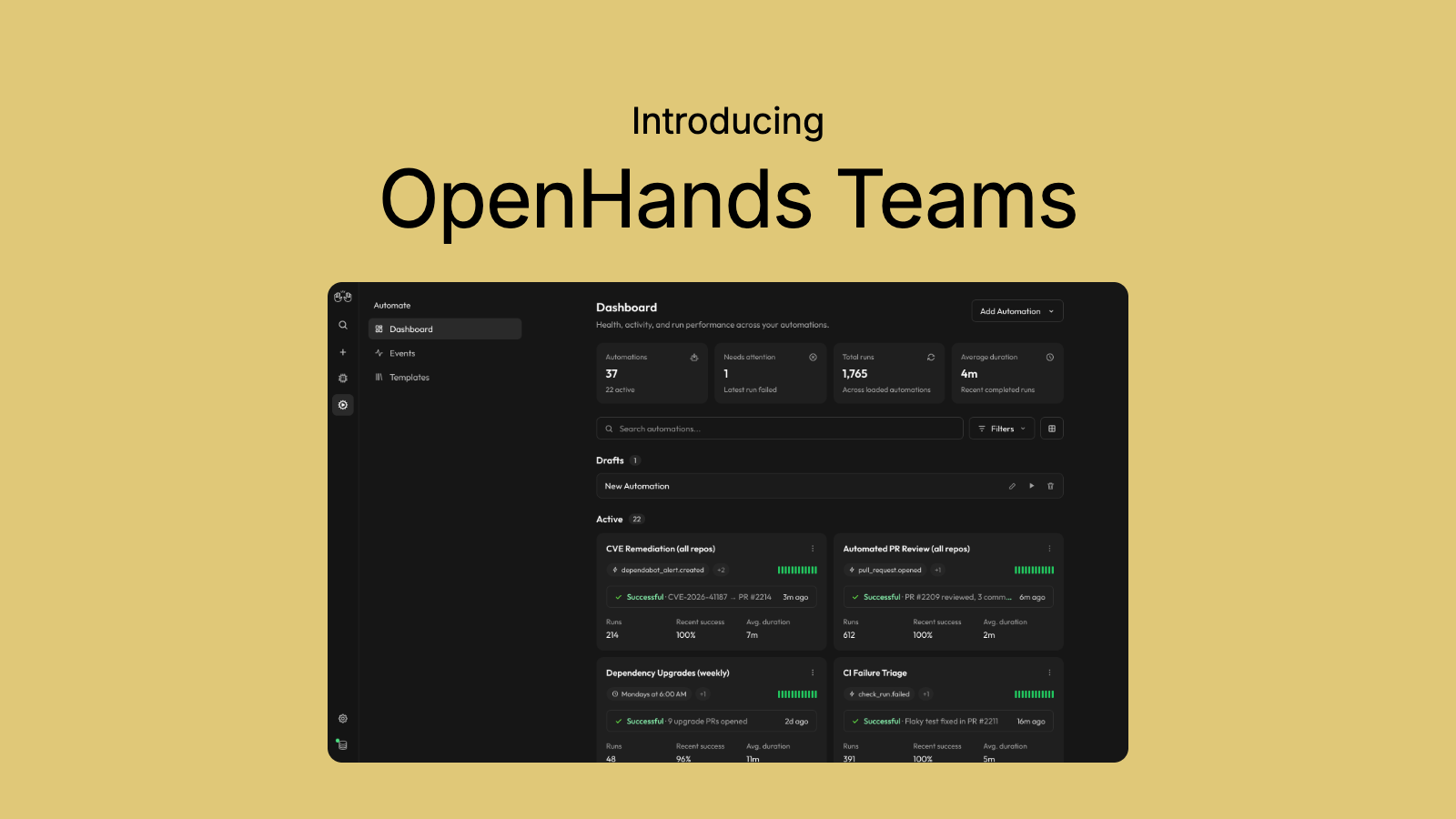
OpenHands Teams brings enterprise AI agent capabilities to engineering teams through self-service, making it easier to build automated engineering workflows on your own infrastructure, starting with vulnerability remediation.
Vulnerability management is becoming increasingly challenging as the number of reported software vulnerabilities continues to grow, with AI-assisted discovery adding to the pressure. Security tools have made it easier to identify vulnerable dependencies and affected applications, but resolving those findings still requires substantial engineering effort. Teams must investigate the impact, determine the appropriate remediation, implement changes, validate the results, and prepare fixes for review. When vulnerabilities affect multiple repositories, that work compounds.
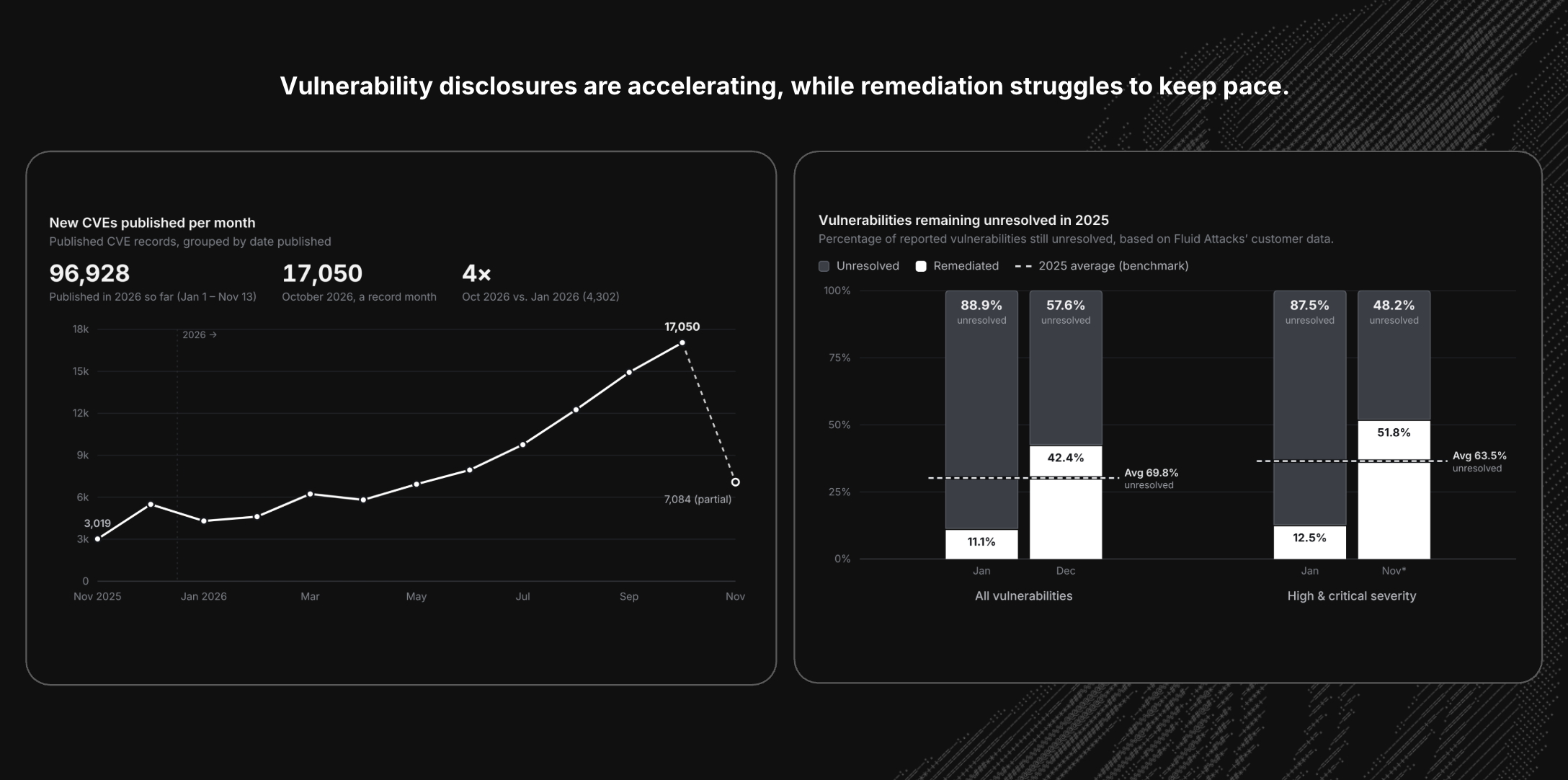
Sources: CVE Tracker (CVE publication data, November 2025–November 2026); Fluid Attacks, State of Attacks 2026 (2025 vulnerability remediation data). CVE counts reflect publicly disclosed vulnerabilities; remediation figures reflect vulnerabilities observed among Fluid Attacks customers. The datasets represent different populations and are not directly comparable.
AI coding agents can tackle individual engineering tasks, but much of that work still depends on someone initiating an agent session and coordinating the next steps. The bigger opportunity is connecting agents to the tools and events that drive engineering work, allowing them to investigate issues, implement changes, and validate results through repeatable workflows, with human oversight where needed.
This is the idea behind AI-powered software factories: combining coding agents with the infrastructure, integrations, and automations needed to handle recurring engineering work across the SDLC.
Today, we’re introducing OpenHands Teams, a new self-service way for developers and engineering teams to access OpenHands Enterprise. Teams makes it possible to deploy OpenHands on your own infrastructure in minutes and start building automated engineering workflows.
Why vulnerability remediation needs a different approach
Organizations already invest in vulnerability scanning, dependency monitoring, and security tooling. These systems help identify potential exposure, but resolving a finding often requires engineers to investigate the affected code, determine the appropriate remediation, implement changes, and validate that the fix doesn’t introduce regressions.
That work becomes particularly demanding when a vulnerable dependency appears across multiple repositories or when a patch requires application changes rather than a straightforward version update.
A typical remediation process involves:
-
Identifying affected repositories and dependencies.
-
Determining whether vulnerable functionality is actually used.
-
Selecting a compatible patch or mitigation.
-
Updating dependencies or application code.
-
Running tests and investigating failures.
-
Preparing changes for developer review.
Each step requires engineering time, often pulling developers away from planned work. As new vulnerabilities are discovered, the backlog can grow faster than teams can investigate and resolve findings.
Coding agents can help with much of this work, but using an agent to address each vulnerability individually doesn’t solve the coordination problem. Someone still needs to identify the issue, provide the right context, initiate the task, and review the results.
By connecting vulnerability findings to repeatable agent workflows, teams can automate much of the investigation, implementation, and validation while retaining human approval over changes.
From individual coding agents to software factories
Individual coding agents can investigate and fix vulnerabilities, but they typically rely on someone to initiate each task. A software factory connects those capabilities to automated workflows that respond to new findings, carry out remediation work, and involve engineers when decisions or approvals are required.
Traditional automation works well when the steps are predictable. Agent-driven workflows can handle tasks that require investigation and adaptation, such as determining whether a dependency upgrade will introduce breaking changes or diagnosing why a vulnerability still appears in production scans after a fix has merged.
How we patch our own container images
We use OpenHands to automate vulnerability remediation for our own product. A scanner checks our container images, including third-party images we redistribute, and an OpenHands automation acts on the findings. The agent’s instructions read less like a script and more like a job description: you own the security patch backlog, and your job is action, not reporting.
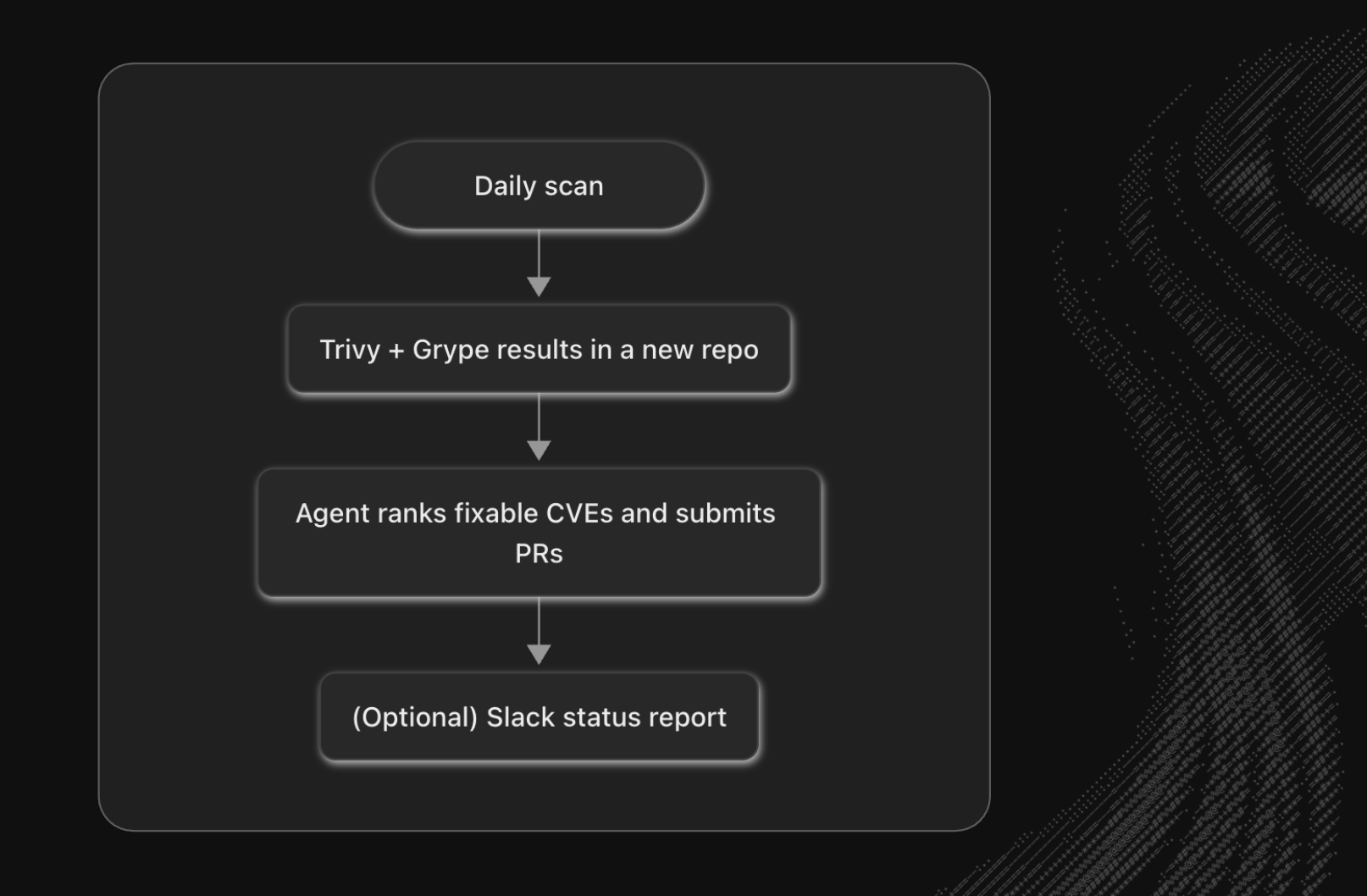
Each run, the agent:
-
Identifies and prioritizes vulnerabilities. It reads the latest scan, focuses on critical and high-severity findings with available fixes, and prioritizes changes based on their impact.
-
Processes existing dependency updates. It updates stale Dependabot branches, investigates minor CI failures, and merges low-risk changes that pass CI.
-
Prepares additional fixes. It opens pull requests for remaining vulnerabilities, grouping compatible changes by repository and separating major version upgrades with documented breaking changes.
-
Validates changes. It runs changes through CI, investigates failures, and revisits unresolved issues in subsequent runs.
-
Verifies remediation in production. A merged PR isn’t the finish line. The workflow tracks findings until subsequent scans confirm that the affected CVEs are no longer reported.
-
Reports progress and escalates decisions. A Slack summary captures what’s merged, what’s still open, and what requires human review.
Guardrails for autonomous remediation
We configure the workflow with explicit rules that limit how the agent operates.
-
Risk-based changes: Each PR receives an explained risk score from 1 to 10, with automated merging limited to low-risk changes that pass CI.
-
Limits on work on progress: The agent is instructed to make no more than three merges per run and maintain no more than three open PRs.
-
No vulnerability suppression: Findings must be resolved through upgrades or rebuilds rather than suppressed.
-
Restricted access: The workflow uses a dedicated machine user and prohibits direct pushes to default or release branches.
-
Respect for developer decisions: PRs closed without merging are not automatically retried.
The workflow combines agent reasoning with the automations, integrations, and execution environments needed to run remediation repeatedly. OpenHands provides the infrastructure to operate these workflows while giving engineering teams visibility into agent activity and control over execution.
Note: This is a reference workflow. Vulnerability detection and triggering depend on the external tools and integrations used.
How OpenHands powers automated remediation workflows
Getting an agent to investigate and fix a vulnerability in one repository is relatively straightforward. Making that workflow reliable enough to run repeatedly across repositories introduces a different set of challenges. Teams need to determine what triggers the agent, what context it receives, where it executes, how it handles failures, and which changes it can make autonomously versus those requiring human approval. They also need visibility into what agents are doing and controls over what they can access.
OpenHands brings these capabilities together in a platform designed for software engineering agents.
OpenHands agents can inspect repositories, modify code, execute commands, and run tests inside isolated execution environments. For vulnerability remediation, this means an agent can investigate an affected dependency, identify a potential fix, implement changes, and validate the changes before preparing a pull request for review.
OpenHands Automations supports scheduled and event-driven workflows through integrations with GitHub and other engineering tools, allowing agents to respond to supported events without manual intervention.
For vulnerability remediation, an automation can connect a security finding to an agent workflow that investigates the issue and prepares a proposed fix. As demonstrated by our container remediation workflow, automations can also revisit unresolved issues, respond to CI failures, and track remediation across subsequent runs.
As automated workflows expand across repositories and teams, organizations need to manage which systems agents can access, where they execute, how much they consume, and what happens during execution.
The OpenHands Agent Control Plane provides centralized capabilities for managing agent execution, access, usage, and activity across teams.
Rather than relying on each developer to configure and supervise agents independently, engineering and platform teams can establish shared controls for how agents operate, monitor their activity, and manage usage across workflows.
Because OpenHands is open source and model-agnostic, teams can inspect and customize how agents work, choose models based on their performance and cost requirements, and deploy within their own infrastructure. This flexibility matters when automated workflows need to operate within existing security policies, development environments, and organizational requirements.
Introducing OpenHands Teams
Building automated engineering workflows shouldn’t require a large enterprise commitment or a lengthy procurement process. Developers and small engineering teams should be able to experiment with these capabilities on their own codebases, establish what works, and expand adoption based on the results.
OpenHands Teams introduces a self-service path to OpenHands Enterprise, giving smaller engineering teams access to the same core agent infrastructure, automations, and controls without committing to a large enterprise deployment.
Teams can sign up, start a 30-day free trial, and deploy OpenHands on their own infrastructure in minutes, without scheduling a demo or talking to sales.
For example, a team could start by automating vulnerability remediation for a single repository. After testing the workflow, reviewing the generated fixes, and establishing confidence in the results, they could expand it to additional services.
What’s included in OpenHands Teams?
OpenHands Teams starts at 50/month. Teams includes the capabilities of OpenHands Enterprise that engineering teams need to build, automate, and manage workflows across their repositories:
-
Automations and integrations: Run scheduled and event-driven workflows with built-in integrations for GitHub, GitLab, Slack, Azure DevOps, Jira, and more.
-
Team management and security: Manage users and permissions with role-based access controls (RBAC) and single sign-on (SSO).
-
Visibility and cost management: Monitor agent activity, manage usage, and set budgets with built-in observability and usage controls.
-
Flexible deployment and model choice: Self-host OpenHands, bring your own LLM, and work with supported third-party coding agents.
-
Extensibility: Connect agents to additional tools and services through MCP and securely manage credentials with secrets management.
OpenHands Teams is designed for smaller engineering teams, with defined usage limits and support through community forums. For organizations that need higher usage limits, multiple organizations, dedicated customer success, or support SLAs, OpenHands Enterprise provides a path to expand.
Start your OpenHands Teams trial →
Start with one workflow. Build toward a software factory.
Vulnerability remediation is one place to start. The same infrastructure can support automated code reviews, dependency maintenance, CI investigations, and other recurring work across the SDLC.
Start a free 30-day trial of OpenHands Teams and deploy on your own infrastructure in minutes.
Want to see how it works first? Join us on December 8th for a technical webinar demonstrating how to build a CVE remediation workflow with OpenHands, from identifying a vulnerable dependency to opening a pull request for review. Save your spot →

Get useful insights in our blog
Insights and updates from the OpenHands team
Sign up for our newsletter for updates, events, and community insights.
OpenHands is the foundation for secure, transparent, model-agnostic coding agents - empowering every software team to build faster with full control.


