OpenHands for Customer Success: You Don't Have to Be a Developer to Use Coding Agents
Written by
Chris Nelson
Published on
Getting a complete picture of any customer used to mean hours of stitching together context across multiple systems. Now I spend that time on what actually matters: my customers. I'm a Customer Success Manager, not a developer — and I built a unified system using OpenHands without writing a single line of code.
The Human Integration Layer
In software, the integration layer is what connects systems that can't talk to each other directly. It's the middleware that reads from one place, translates, and writes to another so that data flows where it needs to go.
At most companies, that integration layer is a Human.
They're the one who opens five systems before a customer call to piece together what's happening. They check the CRM for deal context, the knowledge base for account notes, the support portal for open tickets, Slack for anything someone might have mentioned in passing, and a recording tool for what was said on the last call. Then they try to consolidate all of that into something useful before the conversation starts.
Afterward, they do it in reverse: updating the account page, logging notes, drafting follow-ups, flagging risks, syncing fields across systems so the next person who touches the account has a chance at seeing the full picture.
The specific tools change from company to company. One company uses Gainsight, Salesforce, Zoom, and Zendesk. Another uses HubSpot, Notion, Jira, and Intercom. But the pattern is identical. Customer context is always scattered, and someone always ends up being the middleware that connects it.
This isn't a startup problem or an enterprise problem. It's a scale problem that every company has. Startups feel it because processes aren't yet defined. Large companies feel it because they have more tools, more data, more people, and even more gaps between systems. Either way, a person ends up doing the integration work, and that work doesn't scale.
Our Version of This Problem
When I joined OpenHands, we had all the same ingredients. Customer context lived across multiple systems. Not everyone had access to every tool. There was no single place where someone could understand: who is this customer, what are they trying to accomplish, and what needs attention right now.
With a growing customer base, every hour I spent assembling context was an hour I wasn't spending on the work that actually matters: building relationships, driving adoption, and making customers successful.
I'm not a developer. I didn't write code to build what came next. But I had OpenHands at my fingertips and a real problem to solve. There's no better way to prove the value of your own product than to use it to solve your own problems, and that's exactly what we did.
From Scattered to Structured
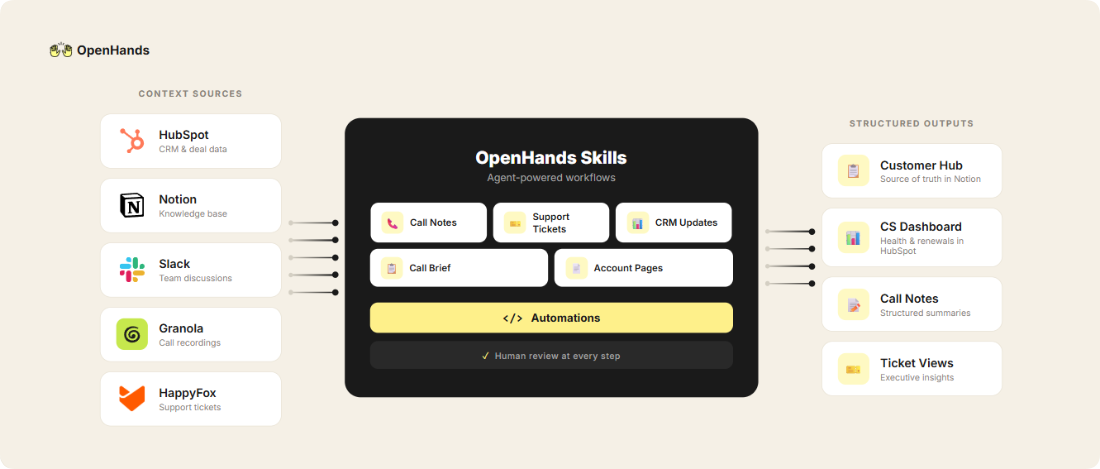
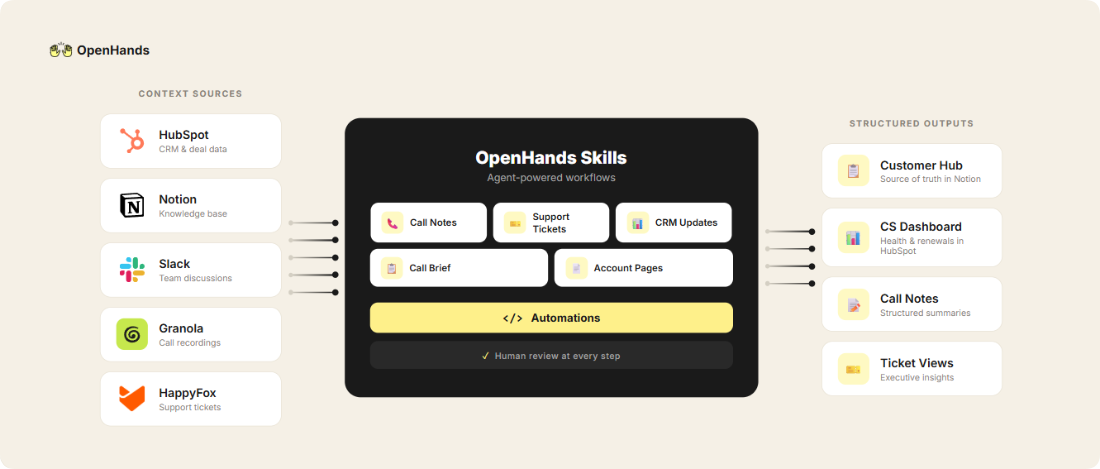
Using OpenHands, I built an internal customer intelligence system. OpenHands connects to tools like Slack, HubSpot, and Notion natively, and reaches others through APIs and MCP. The idea is straightforward: take the context that already exists across those tools and bring it together into a single structured workspace per customer.
I didn't write code to do it. I wrote skills, an open standard for reusable agent workflows that tell the agent what systems to read from, what to produce, and when to pause for human review.
Here's one example. After a customer call, I tell OpenHands: process my latest call with this customer. It pulls the transcript from Granola, reads the current account page in Notion, and cross-references what was discussed against the account's health, priorities, and recent history. From that single conversation, it creates a structured call note, determines what needs updating on the account page, refreshes the fields in HubSpot that power our CS dashboard, and drafts both a customer follow-up and an internal Slack recap.
One skill, multiple systems, and what used to be the most time-consuming part of my day is now one prompt and a review.
What Actually Changed
As a result, a Sales rep looking at a customer workspace doesn't have to ask the CSM for context. An engineer can see what was discussed on the last call. Leadership gets a dashboard view without requesting a report. The information lives in the systems people already use, and it stays current.
Today the system includes:
-
A Customer Hub in Notion — dedicated pages per customer covering everything from why they bought to their current health and risk profile. A single place where anyone can get the full picture.
-
A Customer Success Dashboard in HubSpot — an aggregated view of the entire book of business: renewals, health, last touch dates. Sales and leadership see the full picture at a glance, with links to dig deeper into individual accounts in the Customer Hub.
-
A Call Notes Database powered by Granola — structured notes from every customer engagement and internal standup, with transcripts and summaries, so anyone can see what was discussed and when.
-
A Ticket Database with Executive Views powered by HappyFox — customer-specific tickets, cross-customer trends, and an executive summary that refreshes so leadership always knows what needs attention.
The system has grown organically — one skill, one friction point at a time. As a business scales, new workflows will emerge and new friction points will surface. The difference now is how we respond to them. It's no longer a question of who can own this. It's let's build a skill for it.
This Isn't Just About Customer Success
The pattern here is simple: context is scattered, someone is manually assembling it, and an agent can do that assembly instead.
It's the new hire doing archaeology through Slack, old docs, and spreadsheets just to understand what's going on. It's the analyst who pulls the same data from three systems every Monday morning to build a report nobody has time to automate. It's anyone who has ever said "let me pull that together" and immediately opened five tabs. The hardest part is never the work itself — it's getting to the context you need to do the work.
OpenHands doesn't replace any of these specialized tools. It connects them. Most tools are good at what they do individually. The problem is the gaps between them. OpenHands becomes the integration layer so a person doesn't have to be.
Coding agents aren't just for engineers or developers writing code. They're for anyone with workflows that span multiple systems and require judgment. If your team has scattered context, the same approach works.
The Bigger Picture
OpenHands is built for autonomous software development. That's its core. But the same capabilities that let agents write and ship code also let them connect your operational tools and turn scattered context into something your whole team can actually use.
Every company has a human integration layer. At a startup it might be one or two people. At an enterprise it could be hundreds — every CSM, every sales rep, every ops manager doing the same redundant assembly work in parallel, across the same scattered systems, every single day.
I'm not an engineer. Neither are most of the people doing this work every day. That's exactly why I built this — and exactly why you can too. Find your friction point. Build a skill. See what happens next.


Get useful insights in our blog
Insights and updates from the OpenHands team
Sign up for our newsletter for updates, events, and community insights.
OpenHands is the foundation for secure, transparent, model-agnostic coding agents - empowering every software team to build faster with full control.



